Table of contents
Do you know where in your company specific contracts and contract-related documents are stored, who last edited them, and whether all contracts are still up to date? Do you keep track of all the dates and deadlines related to the contracts, and do you know what payment obligations arise from them and when?
In many places, contracts are still partially stored in physical archives, while newer versions are stored digitally by the relevant departments – on different systems, in different folders and registers, and according to inconsistent structures. That makes it hard to keep track of everything. An electronic contract management system makes it easier for companies to work with contracts and helps optimize business processes related to contract management. Contract management software not only manages the digital filing of documents, but also makes the entire contract management process simpler, more transparent, more efficient, and more secure.
In companies, contracts govern the collaboration between external and internal business partners. Whether it is an employment contract, a framework agreement, a service contract, a non-disclosure agreement, a corporate agreement, a customer agreement, a supplier agreement, or a lease agreement – manually managing contracts ties up time and personnel resources and poses a high business risk.
With digital contract records, you can manage all contracts and related information and documents company-wide – across all departments, teams, and locations. Software-based or digital contract management
helps create contracts easily and in compliance with legal requirements, automates the process through to the final signature, and ensures structured, audit-proof archiving. This will remind you of all obligations arising from the contracts, such as payments, renewals, or cancellations.
Contract management covers the entire contract lifecycle, which includes the creation, negotiation, approval, signing, archiving, and monitoring of contracts within the company. The goal of contract lifecycle management (CLM) is to optimize end-to-end contract processes.

If contracts contain errors or if the obligations arising from them are overlooked, this can be costly for companies. Unnecessary costs and consequently a decline in the company’s financial and operational performance may result if
Contract management software helps minimize these risks. Furthermore, the automation associated with digitization frees up employee resources that can be used more efficiently for other projects and tasks.
The more extensive and complex a company's business processes are, the more contracts organizations have to manage. Contract management software solutions are suitable for various types of contracts used by startups, small and medium-sized businesses, and international corporations or corporate groups, including, among others:
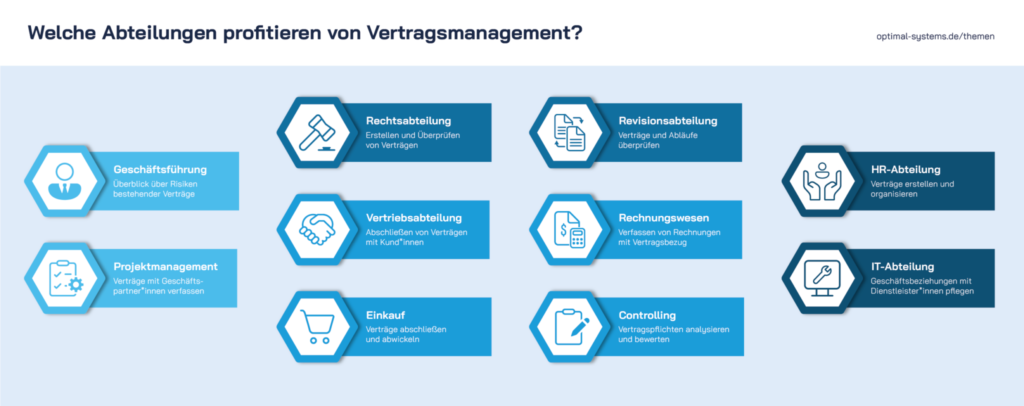
Finance & Controlling
analyzes and evaluates financial obligations arising from contracts.
Purchasing
enters into contracts with suppliers and handles the resulting transactions.
Executive Management
needs a comprehensive overview of existing contracts and potential risks in order to manage the company.
Human Resources
drafts and organizes contracts and agreements with employees.
The IT Department
maintains business relationships with hardware and software providers and other service providers on a contractual basis.
Project Management
drafts and enters into contracts and agreements with customers or other business partners.
Accounting
records incoming and outgoing invoices related to completed customer, supplier, and service contracts.
Legal
drafts and reviews contracts.
The Internal Audit Department
verifies whether contracts and the resulting processes comply with internal and legal requirements.
Sales
enters into contracts with customers.
Everything related to digitization, technologies, and cloud solutions

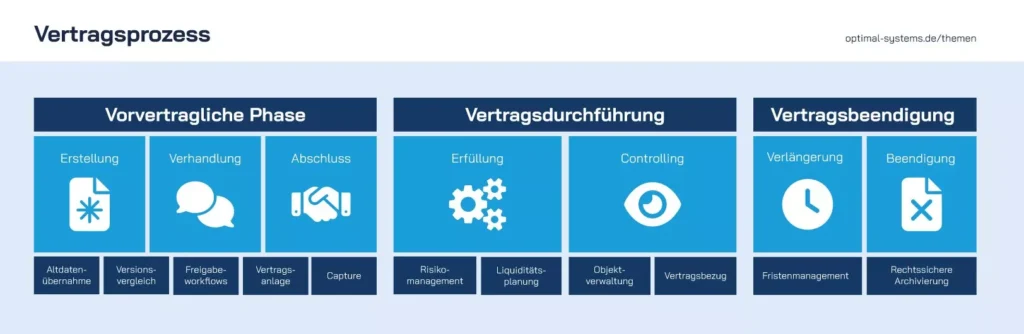
Contract management encompasses all tasks and activities related to contract execution. Contract management is also referred to as contract lifecycle management because it maps out the entire lifecycle of contracts. End-to-end – from creation to archiving or deletion – CLM encompasses three main areas of responsibility:
Contract management includes all steps involved in contract execution. The electronic record, which consolidates all documents and information related to a contract, provides the ideal foundation for this: All contract-related documents – whether newly created, modified, active, or expired (Word and Excel documents, PDFs, image or video files) – as well as e-mail correspondence are stored in a central location. A permission system determines who is allowed to view and edit which documents.
Contract management responsibilities include, among other things:
Contract controlling involves assessing the opportunities and risks arising from contracts. To ensure the most accurate risk assessment possible, it must be possible to monitor and evaluate contracts. This is the only way you can draw conclusions about business performance and take appropriate, timely action. The challenges of contract monitoring relate in particular to:

Managing contracts digitally in an ECM system: a filing location for contract documents in enaio®
The digital archiving of contracts, just like the physical storage of contracts, must comply with the requirements of the GoBD (German Principles for the Proper Management and Retention of Books, Records, and Documents in Electronic Form) and the GDPR (General Data Protection Regulation), and the GeschGehG (Act on the Protection of Trade Secrets). Contracts and contract-related documents (minutes, side letters, images, etc.) must be stored in an audit-proof manner not only during their term but also for a limited period after they expire. Audit-proof archiving of contracts means that
Contracts, as the foundation of business operations, influence your company's economic success. The larger your business becomes, the more difficult it is for you to manage your company-wide contracts using analog contract management tools such as Excel spreadsheets, online tables, or handwritten notes.
A digital contract management tool makes your contract process more structured, efficient, and transparent:
Liabilities and contractual obligations always carry the risk that the terms of the agreements will not be met. Quick and accurate information about contract terms, provisions, clauses, obligations, deadlines, etc., will help you make informed decisions. With software-based contract management solutions, you can minimize contract risks, among other things, through:

Contract types and contractual terms are subject to different regulations depending on the area of application and the country. While in Germany the BGB (German Civil Code) governs the typical types of contracts (contracts governed by law), contracts in Austria are primarily governed by the ABGB (Austrian Civil Code), and those in Switzerland by the Swiss Code of Obligations. In addition to providing contractual certainty, contract management software helps companies adhere to their compliance guidelines: For example, personal data must be protected in compliance with the GDPR, and contracts must be archived in a tamper-proof and audit-compliant manner (GoBD). Digital contract management facilitates, among other things, the
If notice periods are not observed, payment deadlines are missed, or contractual penalties are incurred due to procedural errors, financial losses may result. A software-based contract management system helps ensure that
Contract processes that are streamlined and optimized by eliminating manual errors help improve productivity:
Contract management software is primarily designed to streamline the processing of contracts in a company. To this end, the software “manages” your contracts throughout their entire lifecycle.
Effective contract management begins even before the contract is drafted, during the initial stages of contract negotiation: All necessary information about the contracting parties is stored centrally in the electronic record (customer, supplier, or employee record).
Contract management software simplifies the contract creation process: contracts can be assembled from pre-reviewed text modules without having to create a new document from scratch each time. For example, the draft contract is generated using master data from an ERP system and contract-related information from the electronic record. As a rule, the draft contract is then negotiated, and thanks to contract management software, all versions of the contract are saved until it is finalized, ensuring that the history is transparent and traceable.
In practice, the contract review process is also usually a multi-step process: Contracts that have been fully negotiated are reviewed and approved by supervisors or the legal departments. Through workflows, every employee involved in the process knows which review or approval stage the contract is in.
In fully digitized contract management, digital signatures help complete the contract process quickly and easily. The signed contract is then filed centrally and in an audit-proof manner in the corresponding contract record.
Once the contract has been successfully concluded, the actual contract management begins. At this stage, the software controls all processes and tasks. This way, you can keep track of the terms and deadlines for all your contracts without having to take notes by hand. Automated, timely notifications regarding contract renewals, renegotiations, or terminations help prevent unnecessary costs.
If a contract has finally expired and is not to be renewed, it must still be archived in an audit-proof manner until the end of its retention period and its final destruction. Contract management software helps ensure compliance with retention periods and ensures that documents are protected.
If you search online, you will find a wide variety of providers of contract management software: Vendors that focus on contract management software, with or without digital signatures; IT consulting firms specializing in digital transformation; general software vendors; and companies that focus on comprehensive DMS/ECM solutions.
The best contract management software for your company naturally depends on your specific needs and on which of the available software features you want to use:


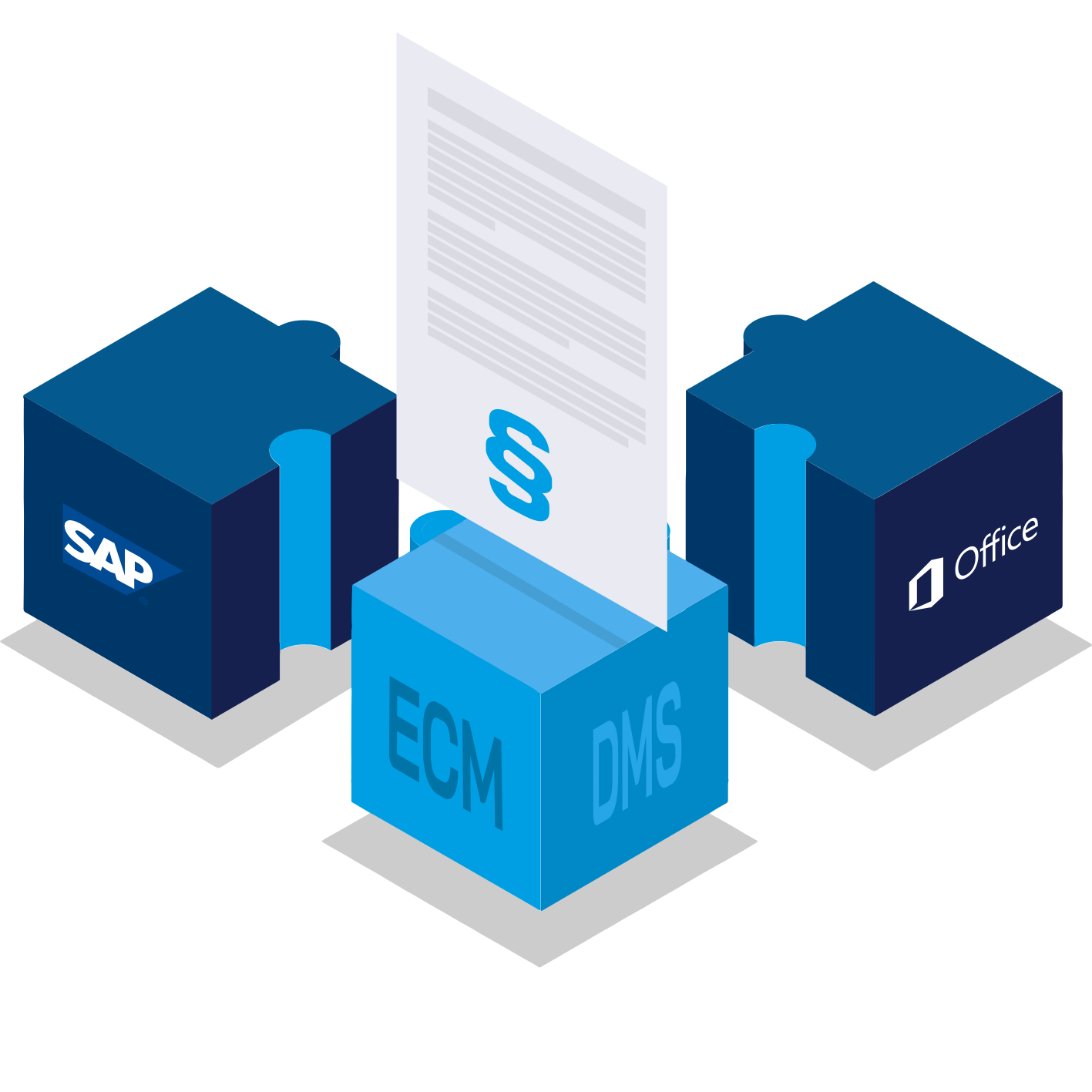

Ideally, your contract management software should be able to integrate with your IT infrastructure. If you want to realize the full potential of contract management, you should avoid duplicative processes and rely on a unified database.
In most companies, documents are created and saved using MS Office programs. To ensure that your teams do not have to give up the “familiar” MS Office environment when using digital contract management software, documents in formats such as Word, Excel, PowerPoint, etc., can be easily imported into the electronic record via drag-and-drop or created from scratch and stored there. E-mails from colleagues, customers, or suppliers, as well as related documents, can also be immediately assigned to the corresponding contract record using a Microsoft 365 integration. Contract-related e-mails can be accessed via the integration with Microsoft Outlook and Exchange and contracts or documents received via e-mail can be archived seamlessly.
When a company-wide ERP system such as SAP is used, connectors and interfaces ensure seamless integration with SAP and thus enable direct data exchange. It is important that the APIs (interfaces) are release-stable and therefore continue to function even after updates and upgrades. Integration with SAP ensures that contracts, documents, e-mails, etc., can be transferred to the ECM system, where they can be processed or managed, and automatically linked to the corresponding business partner in the SAP system.
Whether it is DATEV, financial accounting, CRM, HR, or collaboration – by integrating additional specialized solutions, you can centrally link all documents and information and edit them directly. Interfaces ensure that your teams can collaborate seamlessly.

Gries Deco Company is a specialist in home decor and furnishings, featuring the well-known brands DEPOT, Rooms, and ipuro. Founded more than 60 years ago, the company now has over 5,200 employees in the DACH region.
Under the DEPOT brand, home accessories, furniture, gifts, and decorative items are sold in over 530 stores in Germany, Austria, and Switzerland. At DEPOT stores, which can be found in all major cities in Germany, as well as through partnerships with department stores and home furnishings retailers, customers are offered a wide range of products with a selection that changes seasonally.
Nicole Schmitt has a degree in business administration and has been head of payroll at Gries Deco Company since 2007. With a team of nine, she is responsible for processing monthly payroll, as well as for employment contracts, contract amendments, supplemental agreements, and travel expenses – all the way through to terminations for a specific group of employees.
Employment contracts for store employees (who are paid by the hour) are processed directly by the stores via the intranet using a template form. From there, the contract is transferred via an interface to the central payroll system, where each contract is assigned a personnel number. The contract and employee ID number are then automatically “transferred” to enaio® by OPTIMAL SYSTEMS, where the personnel record is created and the employment contracts for the branches are stored.
In monthly payroll processing, applicant data (applications, certificates, résumés, etc.) is uploaded via an integrated applicant tracking system and imported into enaio®.
During the holiday season (September through November), 3,000 employees are hired and managed through this contract management system in Germany alone. The digitization of contract management is a process that could not be handled accurately and efficiently using manual, paper-based methods. The transfer of application documents from the applicant tracking system to enaio® is just as fast and efficient: The employee record, complete with all its registers, is created in less than 30 minutes.
Before enaio® was introduced, Gries Deco Company used Excel to create checklists for drafting employment contracts and checked off the items manually. This made it possible to verify whether all information and documents relevant to the contract (health insurance membership certificate, the dates on which signed documents were received, etc.) were available. Since they started using enaio®, these checklists have been automatically generated and maintained.
When you need to manage multiple contracts at the same time, an automatic reminder helps you cancel contracts you no longer need in a timely manner, thereby preventing unnecessary payments.
At Gries Deco Company, the contract process is initiated via workflows and automated all the way through to completion. During the term of the contract, a record is kept of who performed which action in the contract lifecycle and when. This way, every single step can be traced even months later. This allows the payroll team at Gries Deco Company to efficiently manage contracts even while working from home.
Despite initial skepticism about digital contract management, Nicole Schmitt sums it up: "Today, we wouldn’t want to be without enaio®. In addition, the setup was very easy. We were also able to configure a lot of things ourselves."
The conclusion of a contract is evidenced by the signatures of the contracting parties. In the analog contract process, the paper document is signed in person by all parties to the contract. To do this, it must be printed out and often sent by mail. The time and cost involved are correspondingly high. In the semi-digital process, the digitally created document is printed, signed by hand, scanned, sent by e-mail, printed again, and signed. Although postal delivery and postage costs are eliminated, the effort involved in making multiple printouts and handling any follow-up inquiries remains. The digital signature simplifies and speeds up the process of signing many times over.
The qualified electronic signature (QES) has a higher security level than the simple electronic signature (image file containing a scanned signature) and the advanced electronic signature (image file containing a scanned signature that is verified for subsequent tampering).
The QES must meet the criteria of the eIDAS regulation Article 26:
This high level of security makes the QES suitable as a signature for nearly all applications, such as contracts of all kinds and tax returns.
When used in conjunction with contract management software, digital signatures simplify the contract management process. In most contracting processes, the contracting parties are located in different places and may also work at different times, so obtaining handwritten signatures from both parties can be very time-consuming. Using a web browser, you can upload the contract document, specify the signers (in order), and start the signing process. Recipients will be notified by e-mail and can sign the document using a computer, tablet, or smartphone. The sender of the contract will be kept informed of each step in the process:
Once all signers have signed and the process is complete, the initiator receives a certificate of completion that provides a legally compliant record of the process.
The enaio® digital contract record
Follow-ups, deadline management, centralized filing, and much more.
Learn more about the capabilities of our premium ECM solution!
Once the decision has been made or a specific directive has been issued to introduce contract management software, a five-step implementation plan can be helpful.
Assessment of the status quo/current situation analysis
During the analysis phase, answer the key questions about your current contract management system, such as:
What types of contracts does your company use?
Which departments or locations in your company work with contracts?
Who has access to contracts or is involved in contract management?
How many orders are created/processed at your company each year?
What are the biggest obstacles right now?
What changes should be made to the status quo, and what results should they lead to?
Determining needs
As a team, write down your “wish list,” such as:
Template management for contract creation
Automation of review and approval processes
Easy-to-use software
Convenient search options for documents and content within the contracts
etc.
Defining software requirements
Integrate your team's requirements list with the technical requirements of your IT department (integration into existing IT infrastructure, interfaces with other software applications).
Work with your stakeholders to determine the type of installation (on-premises or cloud-based).
Set a budget.
Find a solution for how to handle and integrate legacy paper files.
Compare contract management software providers
Get an overview of the software providers:
Evaluate the needs assessment and use it to create a requirements profile that includes the features most important to you.
Make a list of the CLM providers you found during your online research.
Compare the list of CLM providers with your requirements profile.
Select the top 3 to 5 providers to invite for a presentation.
Selection and introduction
Discuss the proposed solutions, as well as the timeline and budget, with the project team and your stakeholders.
Work with the provider to define the implementation steps (who, when, what).
Support the implementation with a comprehensive training program.
Start with one department and roll out digital contract management step by step.
Evaluate the initial results and use them to optimize the process.
Digital contract management refers to the management of contracts using software. It includes the creation, storage, monitoring, and analysis of contracts, as well as automated reminders, appointments, and deadlines. This enables companies to streamline their contract processes and ensure compliance with legal requirements.
Contract monitoring is a subdiscipline of contract management and focuses on the assessment of risks and opportunities.
Contract management software controls the individual steps of the contract management process and digitally integrates them into a single, end-to-end process.
A contract management solution simplifies contract management for all departments. Every step in contract management is transparent to all employees involved. Contract management software handles many routine tasks and reminds users of deadlines and due dates. As a result, the digital solution improves the quality of contract management, saves costs and resources, and increases employee satisfaction.
Cloud contract management offers a number of benefits: With a cloud-based solution, you can, first of all, access your contract data from anywhere and at any time, as long as you have an internet connection. Second, multiple people can access and work on the same contract data at the same time – whether they are in the office, working from home, or on the go. Third, cloud-based solutions are generally scalable, which means you can add more storage space, processing power, or accounts as needed without causing any downtime.

LOCATIONS