Isometrik: Mann mit Laptop sitzt vor großer projizierter Weltkugel

Core Services

High avail­abil­ity and scala­bility for your appli­cation

Layered architecture: the onion approach

We adopted a layered, microservice-based product architecture. At its heart lies the yuuvis® core, a minimal set of microservices required for proper operation.

If you want to add more features and components, you can integrate them as peripheral services. This architectural feature enables you to tailor the system according to your needs.

For example, you can use the client API and frontend we provide as a peripheral service to make it easier for end users to interact with the system; you can use it to integrate a third-party workflow engine, implement a document lifecycle process, or integrate a service for digital signatures or interfaces to further third-party systems.

Learn how to install, configure, use and maintain the core system
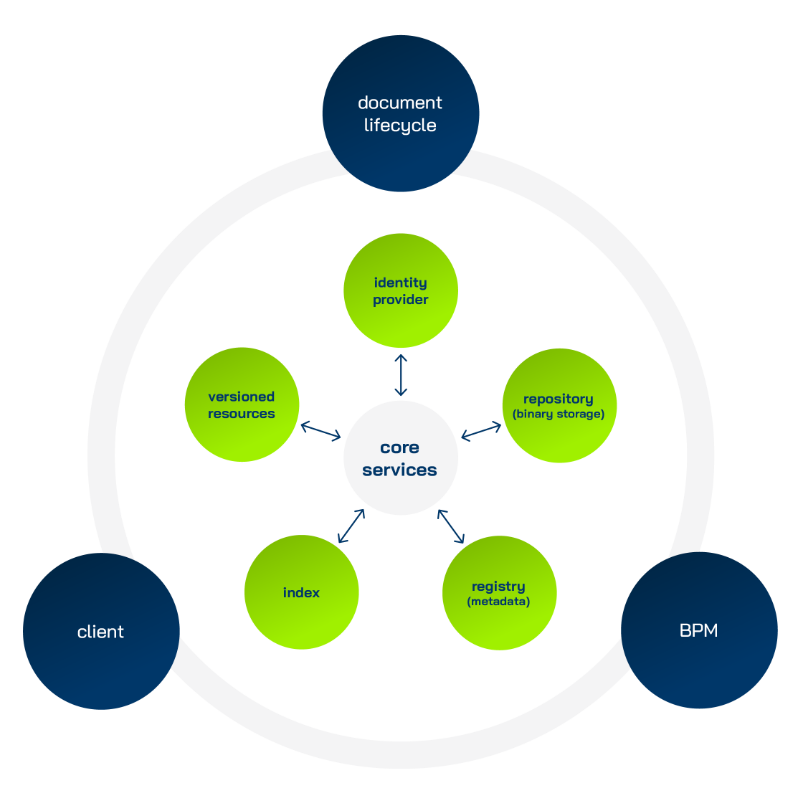
core services structure diagram

Core Services

Zahnrad-Icon

Registry Service

  • Manages metadata describing all stored objects in a database
  • PostgreSQL, Microsoft SQL Server or CockroachDB can be connected
Zahnrad-Icon

Repository Service

  • Speichert binäre Objekte (Dokumente) und deren VersionenStores binary objects (documents) and their versions in a repository in einem Repository
  • S3 via MinIO or a dedicated long-term storage can be connected
Zahnrad-Icon

Index and Search services

  • Connection of a powerful search engine allowing to search for metadata, full text, or both combined
  • Elasticsearch is used to ensure high scalability
Zahnrad-Icon

Configservice

  • Manages versioned resources on a Git server
  • Repository comprising the complete project configuration for transparent versioning, merging or staging
Zahnrad-Icon

Authentication service

  • Connection of an Identity provider for user management based on OAuth2
  • For example, Keycloak can be connected as identity provider
Zahnrad-Icon

Other core services

  • Audit service (object history)
  • Contentanalyzer service
  • Rendition service

Advantages of a microservice architecture

  • Flexible
    The system is adaptable and can be extended with your own business logic.

  • Scalable
    Individual services are scaled up or down depending on the workload of the system.

  • Reliable
    If a microservice fails, a replacement service is started automatically.

Helpful resources

Icon Link

Concepts

Documentation for yuuvis® Momentum in a structured, theoretical way, with links to the tutorial section.

Icon Link

Community

Get answers to your burning questions and find inspiration for your projects in our community.