7 July 2026
By Wissal Saihi

Wissal Saihi
Product Owner at
OPTIMAL SYSTEMS
Invoices, contracts, applications, notices of termination: In many companies, such documents are still reviewed, sorted, and tagged manually, even with ECM in place. This is a time-consuming, error-prone, and poorly scalable process. The reason for this lies in layouts that are trained using machine learning algorithms. We wanted to develop a better solution using AI for this.
When we started development, however, an uncomfortable question arose within the team relatively early on: How much can AI actually accomplish here? The result is our AI component kairos, which serves as the input management system for OPTIMAL SYSTEMS. It is the central point where documents enter an ECM system and are recognized, sorted, and processed.
One of the most fundamental design decisions the team made concerned the question of how kairos "understands" documents in the first place. Traditional capture solutions operate on a rule-based basis: A layout is trained for each document type; any deviation requires rework. It quickly became clear to us that this approach wouldn't give us the robustness we wanted.
Instead of committing to a single technology, we deliberately chose two processing pipelines: an encoder pipeline using traditional machine learning for fast, efficient processing of machine-readable documents, and an LLM pipeline using generative AI for greater flexibility when dealing with unknown layouts. The real challenge wasn't the models themselves, but rather bringing both worlds together under a common interface – the central Predict API – so that the connected systems wouldn't even notice. Since then, for every use case, it has been possible to choose between efficiency and flexibility without changing anything about the integration.
Here's how it works: A document is received, split into individual documents if necessary, assigned to a document type (classification), the relevant values are extracted, and the document – along with a confidence value (i.e., a measure of how reliable the result is) – is transferred to the ECM system.
For us, governance and data protection were part of the architecture from the very beginning. Not added as an afterthought. We have decided to offer tenant-specific models that are trained on each client's data – in an EU-hosted environment. The LLM pipeline also uses EU hosting options. Every AI call is processed centrally via the Predict API. The connection to our ECM system enaio® is established on a tenant-specific basis via the AI Connector using dedicated tenant credentials – similar to a unique access key for each customer – ensuring that data from different tenants remains technically separate from one another.
One point we discussed at length as a team: How much automation is too much? Our solution was to include a confidence score for each result. And to establish a firm rule that, in cases of uncertainty, a human would make the decision. Not a black box, but transparent, correctable results.
By the way, it's no coincidence that our solution is called kairos: The term originates from ancient Greek, where it referred to the opportune, decisive moment – as opposed to time that simply passes in a linear fashion. That is exactly what document processing is all about at its core: not blindly automating everything, but making the right decision at the right moment. Automated where it is safe to do so, and reviewed by a human where necessary.
The next milestone is kairos Configuration Studio – a no-code interface that allows consultants and subject-matter experts to set up classification and extraction for each tenant on their own, without tying up development resources. For our team, this is an important step: moving away from a pure AI engine toward a configurable platform that can be rolled out more quickly to new customers and for new document types.
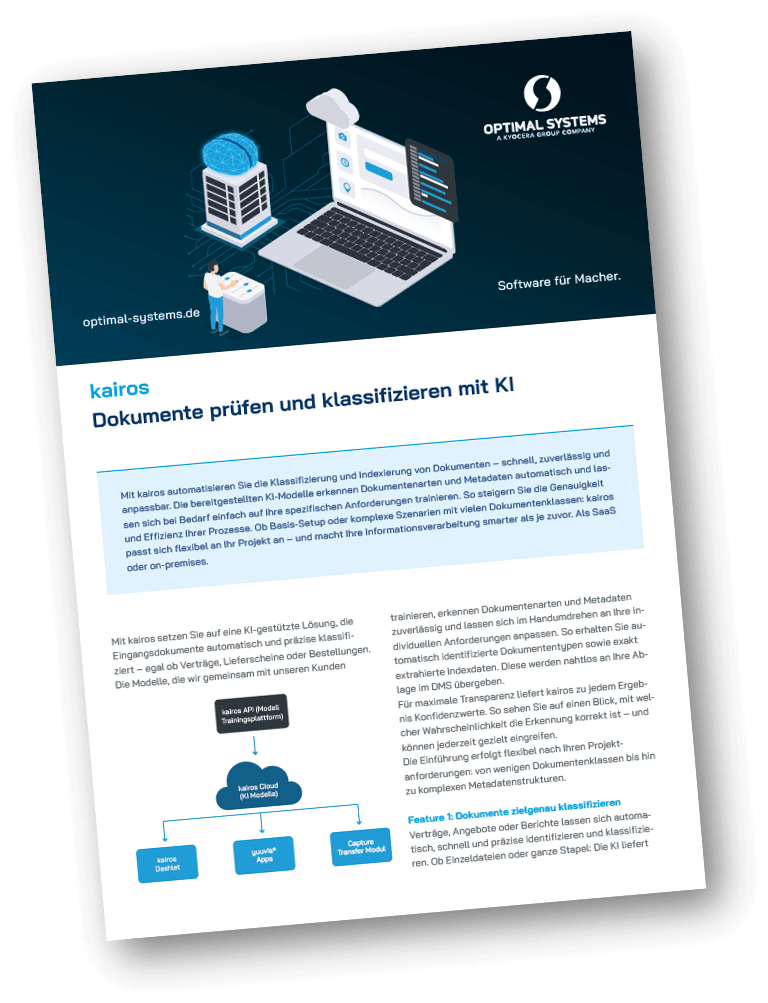
The key features and benefits of the AI-based classification solution
I am convinced that, over the next few years, AI will evolve from an optional feature to an integral part of every DMS – moving away from mere data capture toward true understanding and assistance. At the same time, the importance of traceability and governance is growing, especially in light of the EU AI Act. That was precisely our guiding principle from the very beginning as we developed kairos: AI is meant to lighten the load, not replace people – and trust is built through transparency, not through complete automation at any cost.
Would you like to learn more about kairos?
Get in touch with us!

LOCATIONS