

20. January 2026
By Frank Erbsen
With the enaio® advanced training, our second enaio® standard training is now also available in English for our customers and partners at the OPTIMAL SYSTEMS Academy. I was involved in the translation of the enaio® essentials and enaio® advanced training courses and would now like to share my experiences with you.
What does translation mean in this context? We'd like to translate written texts (training materials) into another language.
There are a few points to consider:
How are the texts translated into the target language?
Is there a practical approach when a large number of different materials need to be translated and it is not yet clear at the beginning what exactly needs to be translated?
Which people, with which competencies, are involved in the translation process, and how can they collaborate efficiently?
Is it ensured that the entire user interface of the system has been properly adapted to the target language?
I’d like to answer these questions using insights from our project experience.
Our texts are translated by specialist translators who are very familiar with the enaio® user interface in German and English. In detailed internal reviews, OPTIMAL SYSTEMS employees ensure that the translated UI labels match the software interface and that the choice of words corresponds to the type of text.
To ensure smooth collaboration between all project participants, we worked with a task board. Due to initial uncertainties, we began with small subtasks to carefully analyze and reflect on the factors that needed attention. This allowed the team to set up effective, lightweight processes from the very beginning. In addition, everyone involved could see clear progress right from the start.
At the beginning, we didn't have a list of everything that needed to be translated. That’s why we began with the most essential materials first: the training manuals. The advantage of this approach was that we could make portions of the training manuals available to interested parties, even before the project was fully completed.
During the translation of the training manuals, we quickly realized that other elements also needed to be translated. Here it was important to continue to focus on the prioritized tasks, but at the same time to add new to-dos directly on the task board.
During the project, we regularly reviewed the task board together, ensuring that everyone clearly knew the status of each task.
One challenge was that we were not able to translate the German training at a fixed point in time, but only step by step over a longer period of time. If updates are made to the training while it is being translated, confusion is almost inevitable without a structured approach. To prevent this, it was agreed with the course owner of the German enaio® advanced training course to freeze content changes, unless they were extremely critical. The course owner, as well as all trainers, could of course continue to make change suggestions in the German enaio® advanced training. However, these were only incorporated after the translation was complete, and applied simultaneously in both training courses. Unavoidable changes occurring in parallel were added to the task board, and the affected content to be translated was marked as locked.
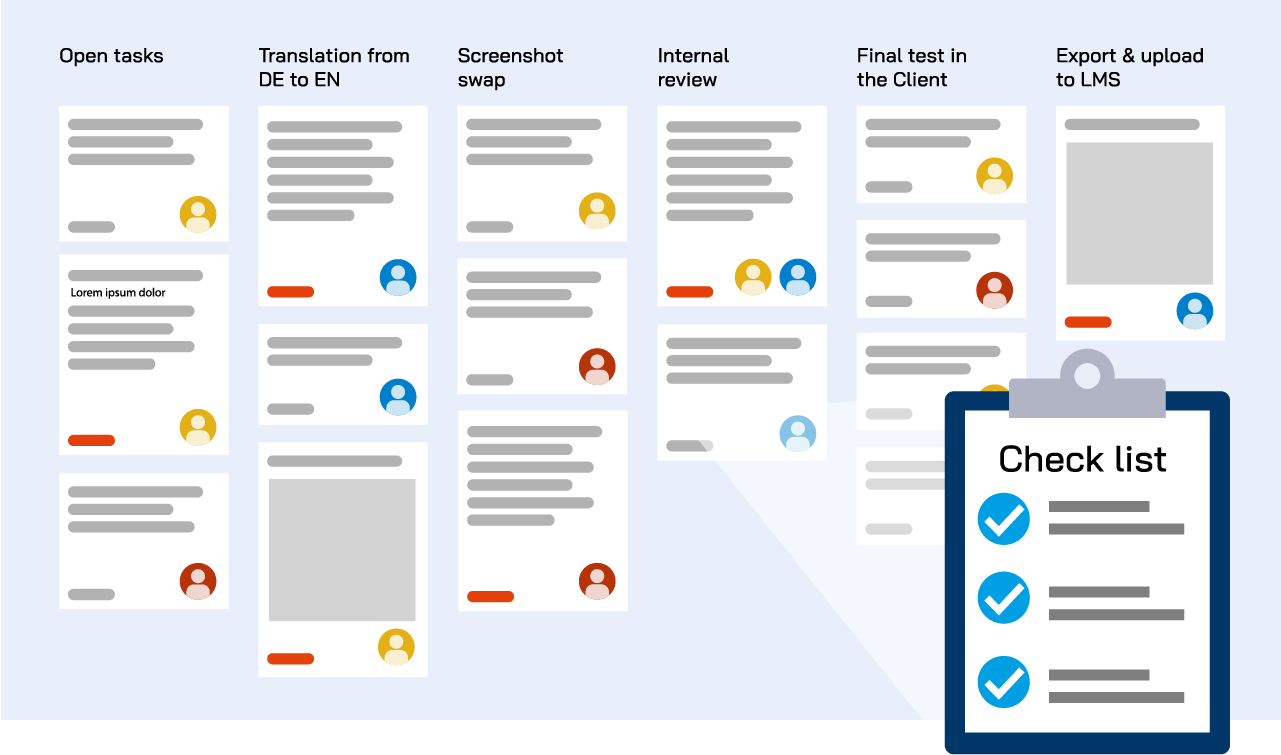
Even after the project is completed, it must be ensured that changes in the German enaio® advanced training are made in parallel in the English enaio® advanced training. To ensure this continues to work smoothly, we will keep using the task board in the future.
Due to the numerous interdependencies between the materials, including the individual training manuals, we implemented a final test as a safety net for the most critical parts of the training. For this purpose, an experienced trainer, who was not part of the project team, completed a full run-through of all the training instructions in sequence. This allowed us to rule out potential side effects and identify inconsistencies that might not have been apparent when reviewing individual instructions in isolation.
Translation requires careful coordination of all parties involved. There are numerous interdependencies between the tasks, as project management, OPTIMAL SYSTEMS Academy administrators, e-learning specialists and the online documentation editors were on board in addition to the specialist translators. With so many people involved, it quickly became clear that they can only be coordinated effectively via a task board.
It is important to pay attention to consistency when adapting to the target language. The labels used in the enaio® program interface must match, as must user-specific elements in the training scenarios, in the training system and at all other parts of the course.
If problems arise here, they could lead to further effort. For example, to enable us to use our enaio® training system for German and English enaio® advanced training, we have adapted the technical labels of the form fields. This had an impact on the instructions for the German enaio® advanced training. Effects on the enaio® workflow training also had to be taken into account.
The translation of an existing training course is just as much a project as the conception of a new training course. However, the challenges are different. A systematic approach is also essential here.
Our wide range of training courses – from brief input to in-depth scenarios – are available via the OS Academy. Whether you're a user, developer, admin or support team member: Everyone will find content that is precisely tailored to their respective tasks and needs.
General Remarks
Software & Services
LOCATIONS