23. March 2026
The head office of OPTIMAL SYSTEMS has moved – from Wilmersdorf to lively Neukölln. The new company site is located exactly where the Estrel hotel complex with its new high-rise building meets the colorful residential area on Sonnenallee. If you look out of the window on one side of the new office, you can see the Neukölln shipping canal with its historic loading cranes. The Ringbahn passes by on the other side. The nearest kebab shop is 100 meters away. You can’t get more Berlin than this.
And this is where the story could end: new office – so what? But the story can also be told in another way. After all, a new location also means a new situation for all employees. OPTIMAL SYSTEMS has been focusing on flexible and mobile working for years. The concept of the flexible workspace has been implemented even more consistently at the new location – deliberately with fewer desks, but at the same time more space for collaboration. If you prefer to work from home, everything stays the same. Those who come into the office can choose between working in one of the large team areas or focusing in a one‑ or two‑person office.
And that's not the whole story either. If you ask our Managing Director Gregor Wolf what makes such a move so special, he puts it in a nutshell as follows: "Even a company that has been digitizing for 30 years and considers itself fully digital can discover that there are still filing cabinets tucked away in a basement when it finally moves." From a C-level perspective, the move is therefore primarily a reality check for the company's own level of digitalization.
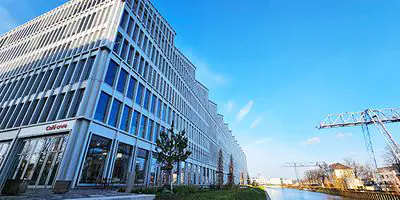


Bright, open and digitalized: our new location on Sonnenallee in Berlin-Neukölln.
To put it bluntly: For our database, in which we handle all document-based processes, the move was completed quickly. As we also use the software we produce ourselves, all employees can access their digital documents immediately and easily as if nothing had happened. And this applies not only to standard Office documents, but also to personnel files, for example. Our HR management team uses our solutions to manage the data of 670 employees.
This is one of the many advantages of a digitalized company. Archives and paper-based filing systems in particular would quickly become a cost driver when relocating. Physical files take up space, incur transportation and storage costs and take up valuable office space. Studies show that companies can achieve space savings of up to 99% by digitizing their archives, as entire rows of folders are replaced by digital archives.
The economic effect goes far beyond a fixed number of square meters. According to a recent Adobe/Statista study, 89% of German companies place a very high value on paper-reduced work – not least because of the measurable cost and efficiency gains. A move is therefore the ideal opportunity to get rid of old analogue inventories by consistently digitizing them. Gregor Wolf therefore advises all companies with relocation plans: "Use this opportunity to get rid of the paper. It's expensive, inflexible – and you can't find anything after years anyway."
And here we come – after the story about the location and the convenient relocation with digital documents – to the third relocation story. It is about the remaining stock of paper that still existed somewhere in the basement at OPTIMAL SYSTEMS: Around 500 folders with old invoices, contracts and insurance documents. You don't just throw something like that away. But if none of it can or should be taken along, it needs to be digitized. What used to be a complex project involving service providers and manual classification is now much easier to implement. An ECM system with AI support automates classification, keywording and indexing.
"Today, all you have to do is scan – an AI does the rest," says our CEO, summarizing the development. This means that the last bits of paper in the company disappear. We took three shelves with us, but they are empty. But better safe than sorry. We didn't even rent a basement. Not even for our servers.

"Even a company that has been digitizing for 30 years and considers itself fully digital can discover that there are still filing cabinets tucked away in a basement when it finally moves. Use this opportunity to get rid of the paper. It's expensive, inflexible – and you can't find anything after years anyway."
Gregor Wolf, CEO of OPTIMAL SYSTEMS
Traditional on-premises infrastructures require server rooms, cooling, security – and therefore space that modern office buildings often deliberately no longer provide. Cloud and SaaS models solve this problem elegantly. Systems run in a data center and employees can access them from any location. At OPTIMAL SYSTEMS, we were consistently committed to this principle even before our move. Our server is located in an external building – the approximately 4.3 terabytes of company data don't even notice that we have moved, so to speak. "Put simply, we just had to plug it back in at a different location after the move," says the IT colleague in charge — a process that took about 30 minutes overall.
A trend that sets a precedent: 81% of companies in Germany already use cloud computing, with a further 14% planning to or discussing it. That's a good thing. No employee should have to wait for their files that are still in a moving truck.
This means for sales, specialist departments and management: A relocation is not just an organizational task, but a strategic lever. Those who digitalize consistently not only reduce space and operating costs, but also improve access to information, accelerate processes and create the basis for further innovations – for example through AI-supported evaluations and automation.
A company relocation is a bit like moving home. You suddenly realize how much stuff you have – and that now is exactly the right time to get rid of it. At the same time, however, a relocation also shows relentlessly how future-proof processes, IT and archives really are. Those who use this moment to digitize documents and rely on cloud-based ECM solutions not only make the move easier – they also ensure more efficient, cost-saving and flexible working. Even for well-digitized companies, this can be a real aha moment. We know that now.
LOCATIONS